A Balloon of Fluid Behind the Knee
A Baker's cyst — also called a popliteal cyst — is a build-up of synovial fluid that forms a bulge in the popliteal fossa, the back of the knee. It is named after the English surgeon Dr. William Morrant Baker, who first described the condition in the 19th century.
It works like a one-way valve: when the knee produces excess fluid — due to osteoarthritis, a meniscal tear, arthritis or other causes — that fluid migrates into the posterior synovial bursa, forming the cyst. The bursa can grow under the pressure, becoming palpable and painful.
The most common mistake is to try to treat the cyst alone. Draining or removing the cyst without treating the underlying cause carries high recurrence rates. The focus should always be on diagnosing and treating the intra-articular problem that drives the excess fluid production.
Treating a Baker's cyst without treating its cause is ineffective. Most recur. Correct treatment always begins by identifying the underlying knee condition.
Baker's Cyst — MRI
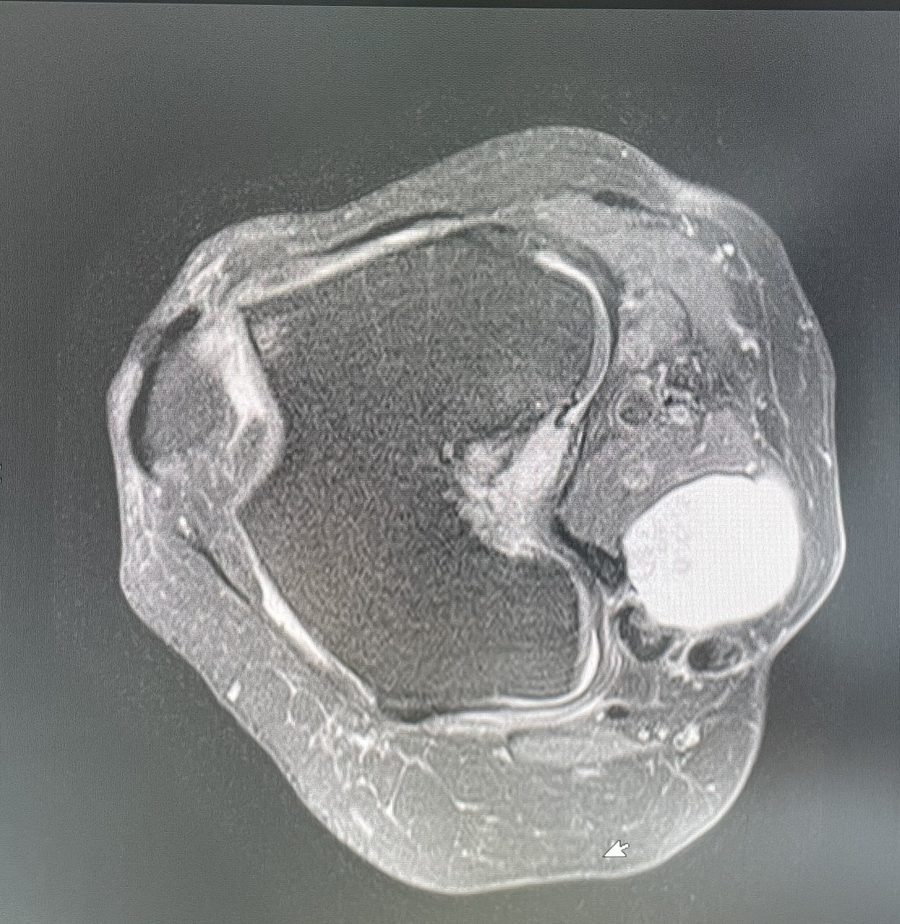
Axial knee MRI: Baker's cyst (fluid-signal structure in the popliteal region).