Joint Degeneration

Knee Osteoarthritis (Gonarthrosis)

Osteoarthritis is the most prevalent joint disease. But having osteoarthritis does not mean you have to undergo surgery — most patients manage their symptoms well with conservative treatment.

Book a Consultation
+60%Adults >65 years with osteoarthritis
4–6×Extra load per kg of body weight
Grade IVMain indication for a replacement
15–20 yearsAverage lifespan of a total replacement

The Progressive Degeneration of the Joint

Knee osteoarthritis (gonarthrosis) is a degenerative disease characterised by progressive deterioration of the articular cartilage, with secondary bony reaction (osteophytes), subchondral sclerosis and synovial inflammation. It is the most prevalent joint disease and one of the leading causes of functional disability in adults.

Gonarthrosis can affect one or more compartments of the knee: medial (the most common), lateral and patellofemoral. The distribution of the disease influences the choice of surgical treatment when this is required.

Osteoarthritis is not inevitably progressive, nor does it equate to surgery. Many patients stabilise with appropriate conservative treatment — physiotherapy, weight control, adapted activity and injections when indicated.

Each kilogram of excess body weight generates 4 to 6 kg of additional load on the knee during walking. Weight loss is the intervention with the greatest impact on the progression of gonarthrosis and on symptoms.

Bilateral Osteoarthritis — Medial Predominance
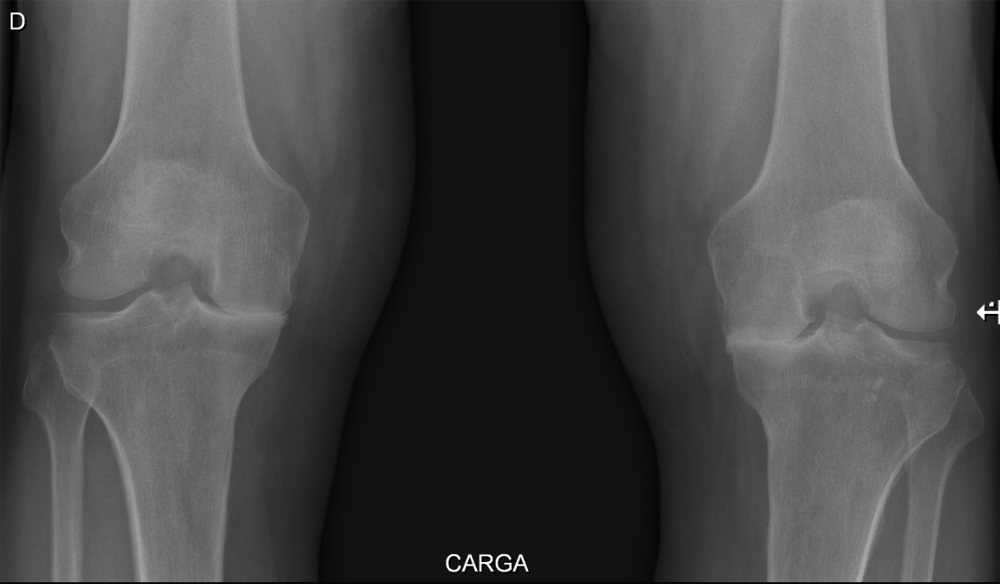
Bilateral Osteoarthritis — Medial Predominance

Weight-bearing X-ray: medial compartment narrowing in both knees.

Kellgren-Lawrence Classification

The Kellgren-Lawrence (KL) classification is the international reference system for staging knee osteoarthritis on X-ray. The grade guides the treatment decision.

GradeDesignationRadiological FindingsClinical Implication
Grade 0 Normal No radiological changes of osteoarthritis. Pain without radiological correlate — investigate other causes.
Grade I Doubtful Minimal osteophytes of doubtful clinical significance. Joint space preserved. Conservative treatment. Optimise modifiable factors.
Grade II Mild Definite osteophytes. Joint space preserved or slightly reduced. Physiotherapy, weight control, injections if symptomatic. Monitoring.
Grade III Moderate Definite osteophytes. Moderate narrowing of the joint space. Subchondral sclerosis. Maximal conservative treatment. Consider osteotomy in younger patients. Unicompartmental replacement.
Grade IV Severe Severe osteophytes. Marked narrowing of the joint space. Subchondral sclerosis. Possible deformity. Main indication for total or unicompartmental replacement. Surgery when symptoms are limiting and conservative options are exhausted.

What Causes and Worsens Gonarthrosis?

Identifying and acting on modifiable factors is the foundation of conservative treatment.

Excess Weight

The modifiable factor with the greatest impact. 4–6 kg of additional load for every kg of excess body weight.

Modifiable

Age

Prevalence increases exponentially after the age of 50. Osteoarthritis is not exclusive to older people — previous injuries accelerate the process.

Non-modifiable

Female Sex

Greater prevalence and severity after the menopause. Hormonal changes influence cartilage homeostasis.

Non-modifiable

Previous Injuries

ACL tears, meniscal injuries and articular fractures significantly accelerate gonarthrosis.

Preventable

Axis Deformity

Varus (bow legs) overloads the medial compartment. Valgus overloads the lateral compartment.

Surgically correctable

Sedentary Lifestyle

Muscle weakness reduces dynamic joint protection. Appropriate exercise is protective, not harmful.

Modifiable

From Conservative to Surgery — In Order

Osteoarthritis is treated in a progressive ladder. Surgery is always the last option — when conservative treatment has been properly attempted and exhausted.

1

Lifestyle Modification

Weight loss (the most important), adapted low-impact exercise (swimming, cycling, walking), avoiding repetitive high-impact activities.

2

Physiotherapy and Muscle Strengthening

Strengthening the quadriceps and hamstrings reduces joint load. Solid evidence even in advanced osteoarthritis. Manual therapy can relieve symptoms.

3

Analgesic and Anti-inflammatory Medication

Paracetamol for regular use; NSAIDs for acute flare-ups. Chronic use of NSAIDs requires renal, cardiovascular and gastrointestinal monitoring.

4

Intra-articular Injections

Corticosteroid (rapid relief of flare-ups), hyaluronic acid (lubrication, modest effect), PRP (growth factors, emerging evidence). None of them "regenerates" cartilage.

5

Joint-Preserving Surgery

Tibial osteotomy (younger patients with varus/valgus), unicompartmental replacement (osteoarthritis of one compartment). These delay or avoid total replacement.

6

Total Knee Replacement

Last line. For advanced tricompartmental osteoarthritis (KL III–IV) with significant functional limitation that has failed all other options. Survivorship >90% at 15 years.

Sport after a knee replacement? Yes. A knee replacement is not the end of an active life — on the contrary, the goal of surgery is to restore pain-free mobility. Most patients return to low- and medium-impact activities: walking, swimming, water aerobics, cycling, golf, hiking, doubles tennis and recreational skiing. It is only advisable to avoid high-intensity repetitive impact (long-distance running, jumping and contact sports), which accelerates implant wear.

Injections — What Works and What Does Not

Injections are valuable in the symptomatic treatment of osteoarthritis — but there are myths worth dispelling.

Corticosteroid

Rapid and effective relief of inflammatory flare-ups. The effect lasts weeks to months. Limit to 3–4 injections/year — excessive use accelerates chondral degeneration.

Solid evidence (symptomatic)

Hyaluronic Acid

Improves joint lubrication. Modest but more prolonged effect than corticosteroid in some patients. Does not regenerate cartilage — the term "viscosupplementation" is more accurate.

Moderate evidence

PRP ("Platelet-Rich Plasma")

Growth factors from the patient's own blood. Growing evidence in KL I–II osteoarthritis. Does not regenerate cartilage — the term "regenerative" is clinically inaccurate and should be avoided.

Moderate evidence (early)

Stem Cells / BMAC

Bone marrow concentrate. Emerging evidence, studies of variable quality. Not approved as a standard treatment. Consider only in centres with research protocols.

Limited evidence
⚠ "Regenerative" injections: PRP, hyaluronic acid and stem cells are frequently marketed as regenerative cartilage treatments. There is no robust evidence of structural regeneration of the articular cartilage with any of these techniques. They may offer symptomatic relief — with realistic indications and expectations — but they do not replace the natural progression of the disease.

Questions about Knee Osteoarthritis

Not necessarily. Most people with osteoarthritis manage their symptoms well without surgery. A replacement is the last option, reserved for advanced osteoarthritis with significant functional limitation that has not responded to appropriate conservative treatment. Many patients with grade III or even IV live for years without needing surgery.
No — appropriate exercise is protective, not harmful. Low-impact exercise (swimming, cycling, walking) strengthens the muscles that protect the joint and improves function. What worsens osteoarthritis is repetitive high-intensity impact (running on hard surfaces, contact sports) and a sedentary lifestyle. Movement is medicine for the joint.
No. No injection currently available regenerates the articular cartilage in a consistent and clinically relevant way. Hyaluronic acid and PRP may offer temporary symptomatic relief — over a few months — but they do not alter the structural progression of the disease. They should be considered as symptomatic treatment with realistic expectations.
The unicompartmental (partial) replacement replaces only the diseased compartment — typically the medial one. It is less invasive, has a faster recovery and preserves the natural ligaments. It is indicated when only one compartment is affected. The total replacement replaces the entire articular surface and is indicated for advanced tricompartmental osteoarthritis.
There is no absolute minimum or maximum age. The decision is based on symptoms, functional limitation and quality of life — not on age. In younger patients, higher activity expectations and the longer exposure time of the implant are factors to weigh up carefully in the decision.
NC

Dr. Nuno Camelo Barbosa

Orthopaedic Surgeon · Knee Subspecialist
Hospital Lusíadas Porto · Hospital Misericórdia Vila do Conde · Paços de Ferreira

OsteoarthritisKnee replacementJoint preservation

Do you have knee osteoarthritis?

A specialist assessment defines the true stage of the disease and the treatment most appropriate to your specific case — avoiding unnecessary surgery or postponing it with quality of life.

Book an Appointment 926 850 194

References

Clinical guidelines and scientific reviews supporting this information.

  1. OARSI guidelines for the non-surgical management of knee, hip and polyarticular osteoarthritis. Osteoarthritis Cartilage, 2019.
  2. AAOS — Management of Osteoarthritis of the Knee (Non-Arthroplasty), 3rd ed.
Dr. Nuno Camelo Barbosa
Orthopaedic surgeon · Knee surgery subspecialty
Peer reviewer (AJSM · KSSTA · OJSM · JEO)
Last medically reviewed: 24 July 2026
Full profile  ·  Book appointment →